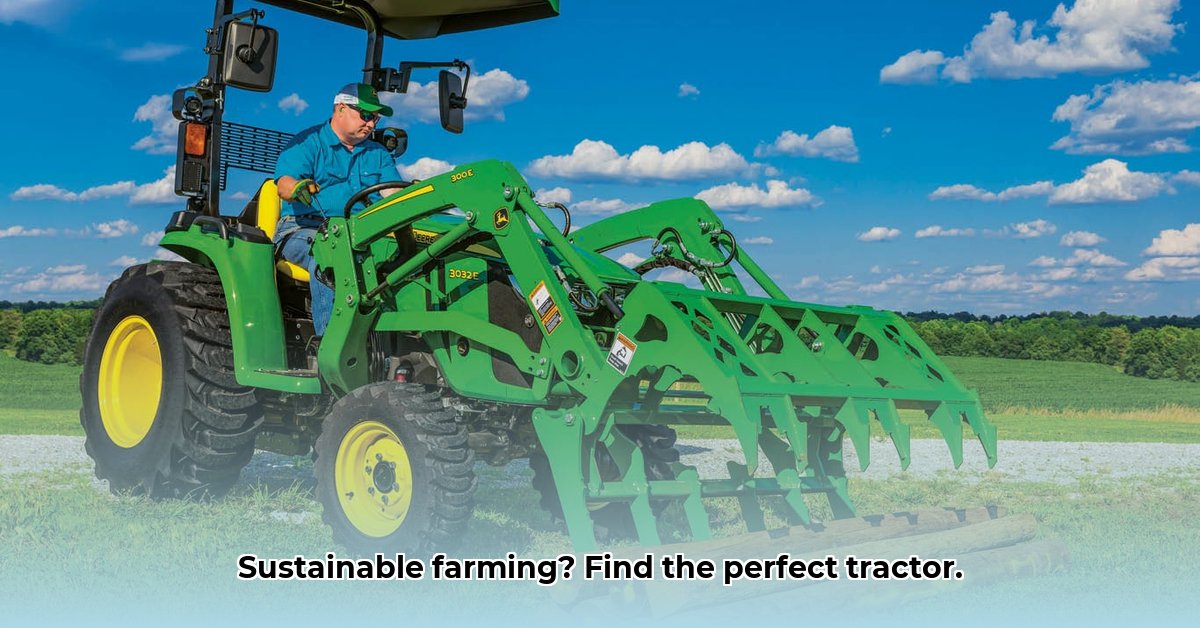
Choosing the right tractor is a significant investment impacting farm efficiency and environmental sustainability. This guide compares four-wheel drive (4WD) and mechanical front-wheel drive (MFWD) tractors, and hydrostatic versus shuttle shift transmissions, considering fuel efficiency, soil health, and cost. For more information on conventional tractors, see this helpful resource.
Drive Systems: 4WD vs. MFWD – Power vs. Precision
The primary decision involves drive systems: 4WD or MFWD. 4WD tractors provide superior traction, ideal for heavy plowing or hilly terrain. However, they consume more fuel. MFWD tractors offer better fuel efficiency and maneuverability, making them suitable for tasks requiring precision, such as planting and spraying. Which system best aligns with your farm's needs and soil conditions? Consider the trade-off between raw power and fuel efficiency.
| Feature | 4WD | MFWD |
|---|---|---|
| Traction | Superior | Very Good |
| Fuel Efficiency | Lower | Higher |
| Maneuverability | Less agile | Excellent |
| Ideal Uses | Heavy plowing, tough terrain | Planting, spraying, smaller fields |
| Soil Compaction | Higher (generally) | Lower (generally) |
Transmission Types: Hydrostatic vs. Shuttle Shift – Control and Efficiency
Transmission systems significantly impact ease of use and efficiency. Hydrostatic transmissions provide infinitely variable speed control, enhancing precision for delicate tasks. Their complexity, however, can lead to higher maintenance costs. Shuttle shift transmissions are simpler and more robust, ideal for heavy-duty work requiring consistent PTO power. The choice depends on the balance you seek between precision control and straightforward operation. Which system best meets your operational requirements?
| Feature | Hydrostatic Transmission | Shuttle Shift Transmission |
|---|---|---|
| Speed Control | Infinitely variable | Set speeds |
| Ease of Use | Very user-friendly and precise | Simpler to learn, but less precise |
| Maintenance | More complex and potentially costly | Generally simpler and cheaper |
| Ideal Uses | Precision tasks, smaller farms | Heavy-duty tasks, large farms |
| Responsiveness | Excellent, instant response | Good, but slight delay possible |
Sustainable Agriculture Considerations: Environmental Impact
Sustainable farming demands minimizing environmental impact. Fuel efficiency is paramount. MFWD tractors generally consume less fuel than 4WD tractors, reducing the carbon footprint. Soil compaction is another critical factor. MFWD tractors, being lighter, often cause less soil compaction than 4WD models, promoting healthier soil. Reducing fuel consumption and soil compaction directly contributes to more sustainable farming practices.
Cost Analysis: A Holistic Perspective
The total cost of ownership extends beyond the initial purchase price. Consider fuel consumption, maintenance, and potential repairs over the tractor's lifespan. While 4WD tractors may have higher upfront costs, their durability may offset this over time, especially on larger farms. MFWD tractors typically boast lower initial costs and improved fuel economy, potentially making them more economically viable for smaller farms. A comprehensive cost analysis, considering all factors, is crucial for informed decision-making. Is the higher initial investment in a 4WD tractor justified by its long-term performance and capabilities?
Conclusion: Matching Tractor to Farm Needs
Selecting a tractor requires careful consideration of farm size, typical tasks, soil types, and budget. MFWD tractors often prove cost-effective and environmentally friendly for smaller farms focused on precision tasks. Larger farms tackling heavy-duty operations may benefit from a 4WD tractor's increased power and traction. The ideal tractor ensures efficient operation while minimizing environmental impacts. Remember, the long-term consequences of your choice extend beyond immediate costs. How will your tractor contribute to your overall farming sustainability goals?